Pooh bear is a simple bear, a curious bear, a thoughtful bear and an inspiring bear.
Satisfied with sticks, honey and his friends, he pondered life and the big world as only a bear can.
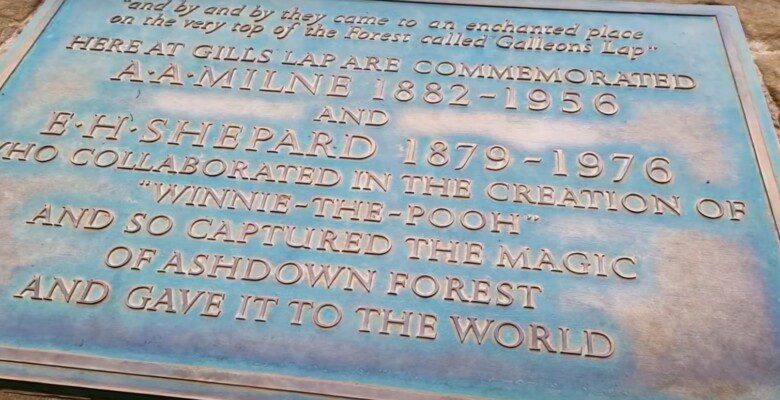
Ashdown Forest, in Southeast England, is famous as the magical landscape that inspired one of the world’s best loved children’s stories; The Adventures of Winnie-the-Pooh.
Situated within the High Weald Area of Outstanding Natural Beauty, its lowland heathland and deciduous woodland habitats are home to many rare and threatened species.
The iconic British bear created by Alan Alexander Milne (A.A. Milne) who lived on the edge of the Forest, conjured stories inspired by explorations with his young son, Christopher Robin.
Christopher Robin Milnes’ stuffed bear, originally named Edward, was renamed Winnie after a Canadian black bear named Winnie (after Winnipeg), which was used as a military mascot in World War I, and left to London Zoo during the war.
“The Pooh” comes from a swan that the young Milne named “Pooh”.
E. H. Shepard illustrated the original Pooh books.
The original illustrated map of The Hundred Acre Wood, which features in the opening pages of A.A. Milne’s Winnie-the-Pooh, sold for £430,000 in 2018.
Pooh first appeared in the London Evening News on Christmas Eve, 1925, in a story called “The Wrong Sort of Bees”.
The original Winnie-the-Pooh, and his friends Eeyore, Piglet, Kanga, and Tigger (Roo was unfortunately lost in an apple orchard during the 1930s) took up residence at The New York Public Library in 1987 and are visited by thousands of people each year.
The stuffed animals range in height from 25″ (Eeyore, the biggest) to 4 1/2″ (Piglet, the smallest).
Understanding Military trauma
It is thought that A. A. Milne, a veteran of both World Wars, was struggling to explain the harsh reality of conflict to his own child when he penned the 1926 children’s classic, “Winnie-the-Pooh.“
It’s been theorized by Dr. Sarah Shea that Milne wrote into each character of “Winnie-the-Pooh” a different psychological disorder.
In an article on Military.com the writer suggests that that the stories were a way for Milne to explain his own post-traumatic stress to his six-year-old son.
Piglet is paranoia, Eeyore is depression, Tigger is impulsive behaviors, Rabbit is perfectionism-caused aggression, Owl is memory loss, and Kanga & Roo represent over-protection.
Christopher Robin Milne eventually followed in his father’s footsteps and they both served in the Second World War.
His father was a Captain in the British Home Guard and he served as a Sapper in the Royal Engineers.
Follow in Poohs paws
Two walks are designed to take you to all the notable locations from the books – the Short Pooh Walk is 0.6 miles (1km) and the Long Pooh Walk is 2 miles (3.25km).
More information
Exploring the Real Hundred Acre Wood and Pooh Corner in Ashdown Forest