It is said that reading a book can take you on a journey into a world far beyond the physical pages and words in front of you. This is also true when you go for a walk and allow yourself to become immersed in the smells, sounds and images that surround you.
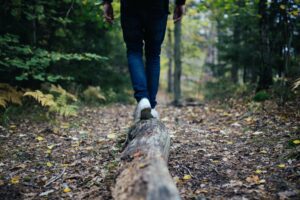
From one step to the next something changes. It could be the sound of your footsteps, the scent from a nearby flower or the picture of a soggy child running between puddles on the way home from school.
Sadly in our modern human world we often blank out our surroundings in the quest to get somewhere or do something. How many times do you walk down the street oblivious to your surroundings with headphones on and looking at your phone screen ? We have all done it, so you are not alone.
Walking is good for you
Constant isolation from the natural world has been proven to be detrimental to health. Many studies have shown that walking and interacting with nature offers cognitive benefits.
Exposure to nature not only makes you feel better emotionally, it contributes to your physical wellbeing, reducing blood pressure, heart rate, muscle tension, and the production of stress hormones. It may even reduce mortality, according to scientists such as public health researchers Stamatakis and Mitchell.
“Nature deprivation,” a lack of time in the natural world, largely due to hours spent in front of TV or computer screens, has been associated, unsurprisingly, with depression. More unexpected are studies by Weinstein and others that associate screen time with loss of empathy and a lack of altruism.
Taking a walk has been proven to offer many health benefits. However, this research has been supercharged recently by the millions of people reporting mental heath problems thought to be as a result of the Covid 19 lockdowns in 2020 and 2021.
Although the long term impact of lockdowns will, by their very nature, take a while to be fully understood we each can aid our own daily wellbeing by walking at least a few times per week and ideally in a space occupied by plants, birds, flowers and other forms of nature.
Sources:
Berman MG, Jonides J, Kaplan S. The cognitive benefits of interacting with nature. Psychol Sci. 2008 Dec;19(12):1207-12. doi: 10.1111/j.1467-9280.2008.02225.x. PMID: 19121124.
https://www.takingcharge.csh.umn.edu/how-does-nature-impact-our-wellbeing#
Sounds of nature : https://www.freesoundslibrary.com/morning-nature-sounds-mp3-free-download/
Featured image by James Francis on Unsplash
Exposure to nature and mental health outcomes during COVID-19 lockdown. A comparison between Portugal and Spain https://www.sciencedirect.com/science/article/pii/S0160412021002890
The urban brain: analysing outdoor physical activity with mobile EEG